

Where to get funding for a business
Starting or growing a business requires capital. The right source of funding depends on the stage of the business, the amount you need, whether you can provide collateral, and whether you are willing to give up part of the company.
The most common options include personal savings, loans, government support, and private investment.
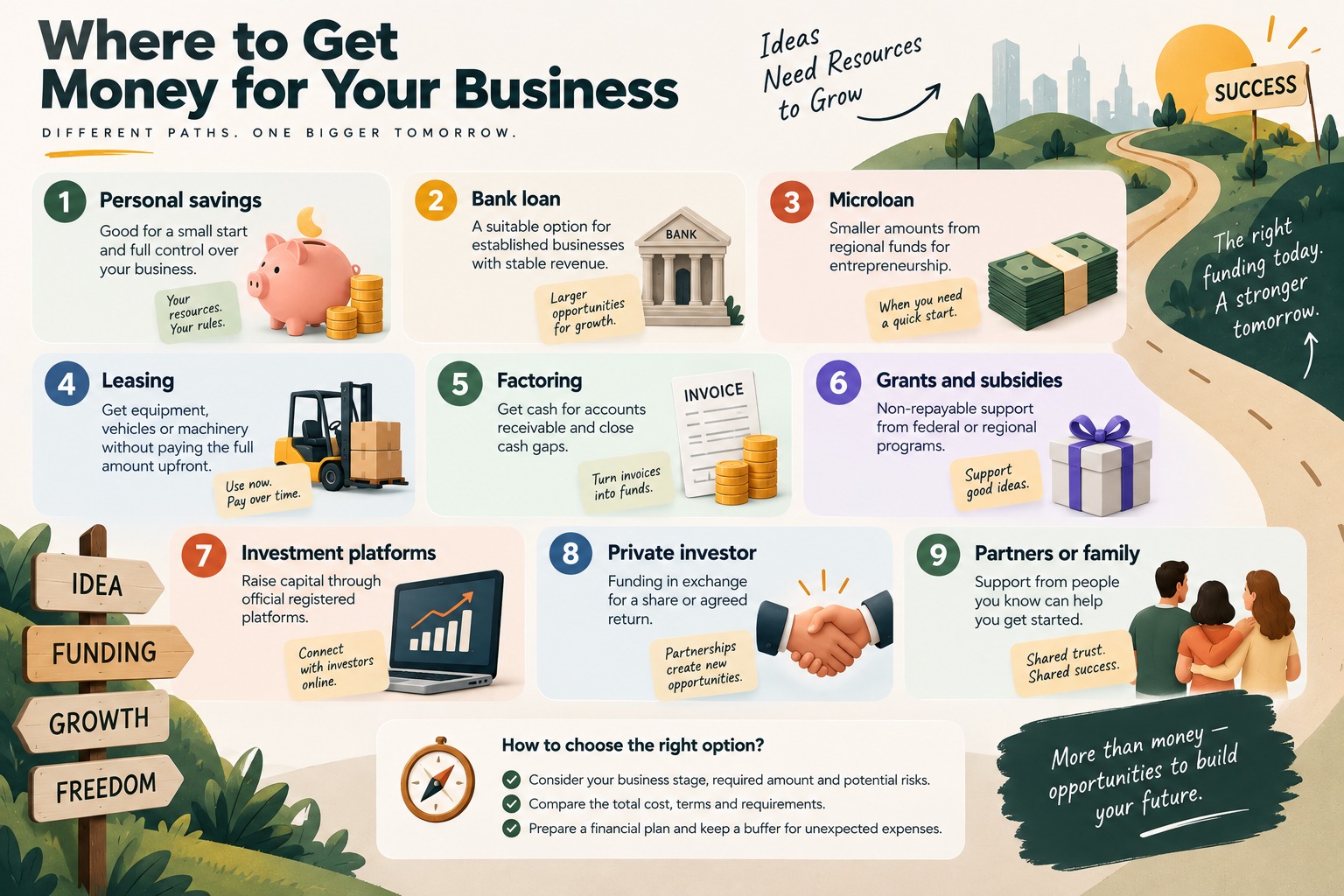
1. Personal savings
Using your own money can be a good option for a small business or an early-stage project. It also allows you to keep full control of the company.
The main risk is losing your personal savings if the business does not perform as expected. For this reason, it is usually better to keep an emergency fund separate from the money you invest in the business.
2. Bank loan
A bank loan is often more suitable for established businesses with stable revenue and a clear financial model.
In addition to standard business loans, banks may offer lines of credit and overdraft facilities. Before choosing a loan, compare the total cost of borrowing, interest rates, collateral requirements, repayment terms, and fees.
Small and medium-sized businesses may also have access to government-backed or subsidized loan programs. These programs vary by country and may support industries such as manufacturing, technology, tourism, logistics, research, clean energy, and other priority sectors.
Government-backed guarantees may also help businesses that do not have enough collateral to qualify for a traditional loan.
3. Microloan
Microloans provide relatively small amounts of funding for starting or developing a business.
Depending on the country, they may be available through nonprofit lenders, community finance organizations, specialized financial institutions, or government-supported programs.
A microloan can be useful when a traditional bank loan is difficult to obtain or when the business only needs a limited amount of capital.
4. Leasing
If a business needs equipment, vehicles, or machinery, it may not be necessary to pay the full purchase price upfront.
With leasing, a finance company purchases the asset and allows the business to use it in exchange for regular payments. This can reduce the initial cash requirement and help preserve working capital.
Some countries also offer financing or incentive programs that make equipment purchases or leasing more affordable for small businesses.
5. Factoring
Businesses that sell goods or services on payment terms can use factoring to access cash before their customers pay their invoices.
A factoring company usually advances most of the invoice value and collects payment later. This can help reduce cash flow gaps and provide working capital for day-to-day operations.
However, factoring fees can be significant, so businesses should compare the cost with other short-term financing options.
6. Grants and subsidies
Government agencies, local authorities, nonprofit organizations, universities, and development programs may provide grants or subsidies to businesses.
Unlike a loan, this type of funding usually does not need to be repaid. However, it is often available only for specific purposes and comes with strict eligibility and reporting requirements.
Applications may require a business plan, financial projections, a project description, and evidence of how the money will be spent.
7. Crowdfunding and investment platforms
Businesses can also raise money through regulated crowdfunding and investment platforms.
Depending on the platform and local regulations, funding may take the form of a loan, an investment in exchange for equity, or contributions from a large number of individual backers.

Before raising money through a platform, check its fees, legal requirements, investor obligations, and the total cost of funding.
8. Private investors
A private investor can provide capital in exchange for equity in the company or another form of agreed return.
This option is especially common for startups and businesses with strong growth potential. Angel investors and venture capital firms may also provide industry expertise, business contacts, and strategic support.
Before accepting an investment, the parties should clearly define ownership, decision-making rights, future funding obligations, profit distribution, and exit terms in a legal agreement.
9. Money from partners, friends, or family
Business partners, friends, or family members can sometimes provide funding without the complex approval process required by banks or professional investors.
Even when there is a high level of trust, the agreement should be documented. It should clearly state the amount provided, whether the money is a loan or an investment, repayment terms, interest if applicable, ownership rights, and the responsibilities of each party.
How to choose a funding source
The best option depends on what the money is needed for.
For a short-term cash flow gap, factoring, an overdraft, or a business line of credit may be suitable. Leasing can make sense when the business needs equipment or vehicles.
For a small business launch, personal savings, a microloan, or a grant may be enough. A business with strong growth potential may benefit from angel investment, venture capital, or equity crowdfunding.
Before raising capital, calculate how much the business can afford to repay or give up in equity. Prepare a financial plan, estimate the total cost of funding, and keep a cash reserve for unexpected expenses.