

What small business can you start?
Today, it often makes more sense to build a small business around a specific problem rather than chase the latest trend. It is usually easier to explain the value of a business when it saves customers time, reduces costs, solves an everyday problem, or delivers a clear result.
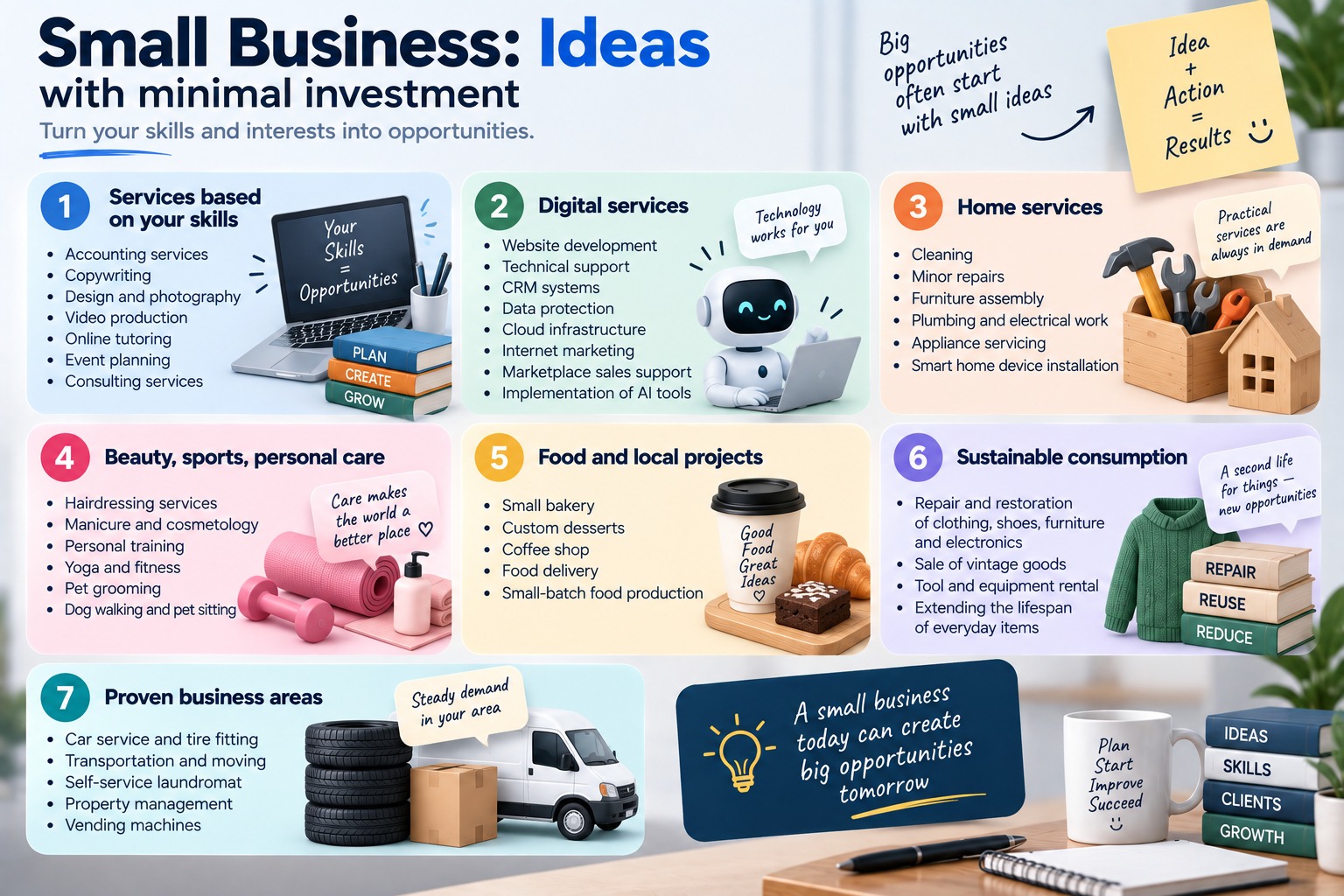
This creates many options for people considering what small business they can start. These include local services, niche e-commerce, AI-powered services, repair and reuse businesses, and services that help individuals or small companies handle routine tasks.
Small business ideas with low startup costs
One of the easiest ways to start is to build a business around skills you already have. Examples include bookkeeping, copywriting, graphic design, photography, video production, online tutoring, event planning, and consulting.
Startup costs are often limited to equipment, software, marketing, insurance, and business registration.
AI-related services are another promising area. Small businesses may need help setting up chatbots, automating repetitive tasks, creating knowledge bases, managing customer inquiries, or training employees to use new AI tools effectively.
Digital services
Digital services continue to offer many opportunities. Businesses may provide website development, technical support, customer relationship management systems, cybersecurity services, cloud infrastructure support, or digital marketing.
Another growing niche is e-commerce support. Services can include product listing optimization, inventory analysis, content creation, product photography, advertising, and marketplace management.
Home services
Practical local services include cleaning, handyman work, furniture assembly, plumbing, electrical work, appliance repair, and smart home installation.
For anyone considering what small business to start without building a complex infrastructure, these services can be a practical option. Many can begin with a small customer base and grow through referrals, local marketing, and repeat business.
Beauty, fitness, and personal care
Hair salons, nail studios, personal training, yoga classes, pet grooming, dog walking, and pet sitting can all become viable small businesses.
Before choosing a business model, it is important to check local health and safety rules, insurance requirements, zoning regulations, and whether specific services require professional certification or a license. Requirements can vary significantly between countries, states, and cities.
Food and local businesses
For those wondering what small business to start in the food sector, possible options include a small bakery, custom desserts, a coffee shop, meal delivery, catering, or small-batch food production.
Competing on price alone can be difficult. A clear specialization, easy ordering process, consistent quality, and memorable concept can help a small food business stand out.
Repair, reuse, and sustainable consumption
Repair and reuse businesses can also create opportunities. Examples include clothing alterations, shoe repair, furniture restoration, electronics repair, vintage resale, and equipment or tool rental.
These business models can generate revenue by extending the life of existing products while helping customers avoid unnecessary purchases.
Established business models
Auto repair, tire services, transportation, moving services, self-service laundries, property management, and vending businesses remain well-established options.

They often require more startup capital than service-based businesses. However, demand may be easier to estimate because these businesses usually serve customers within a specific geographic area.
How to choose a small business idea
A strong business idea solves a clear problem and has measurable demand. Before investing significant money, consider the target audience, competition, average transaction value, operating costs, repeat purchase potential, and expected time to profitability.
It is often useful to test an idea on a small scale first. You could collect early customer inquiries, offer a limited range of services, run a pre-sale campaign, or produce a small test batch before making a larger investment.
Before launching, you should also choose an appropriate business structure and understand the tax rules that apply in your country or region. Depending on the type of business and location, you may need to register the company, collect sales tax or VAT, purchase insurance, obtain permits, comply with health and safety rules, or secure a professional license.
Requirements vary between the United States, European countries, and other markets, so local regulations should always be checked before starting operations.
The best small business does not have to be the most unusual one. Sustainable demand, clear economics, manageable startup costs, and the ability to expand gradually are usually more important than originality alone.