

How businesses can work with a niche audience
A niche audience is a relatively small group of customers with specific interests, needs, or product requirements. Working with such a segment is not about maximizing reach. Instead, it requires a precise understanding of customer needs and the ability to communicate in a way that resonates with them.
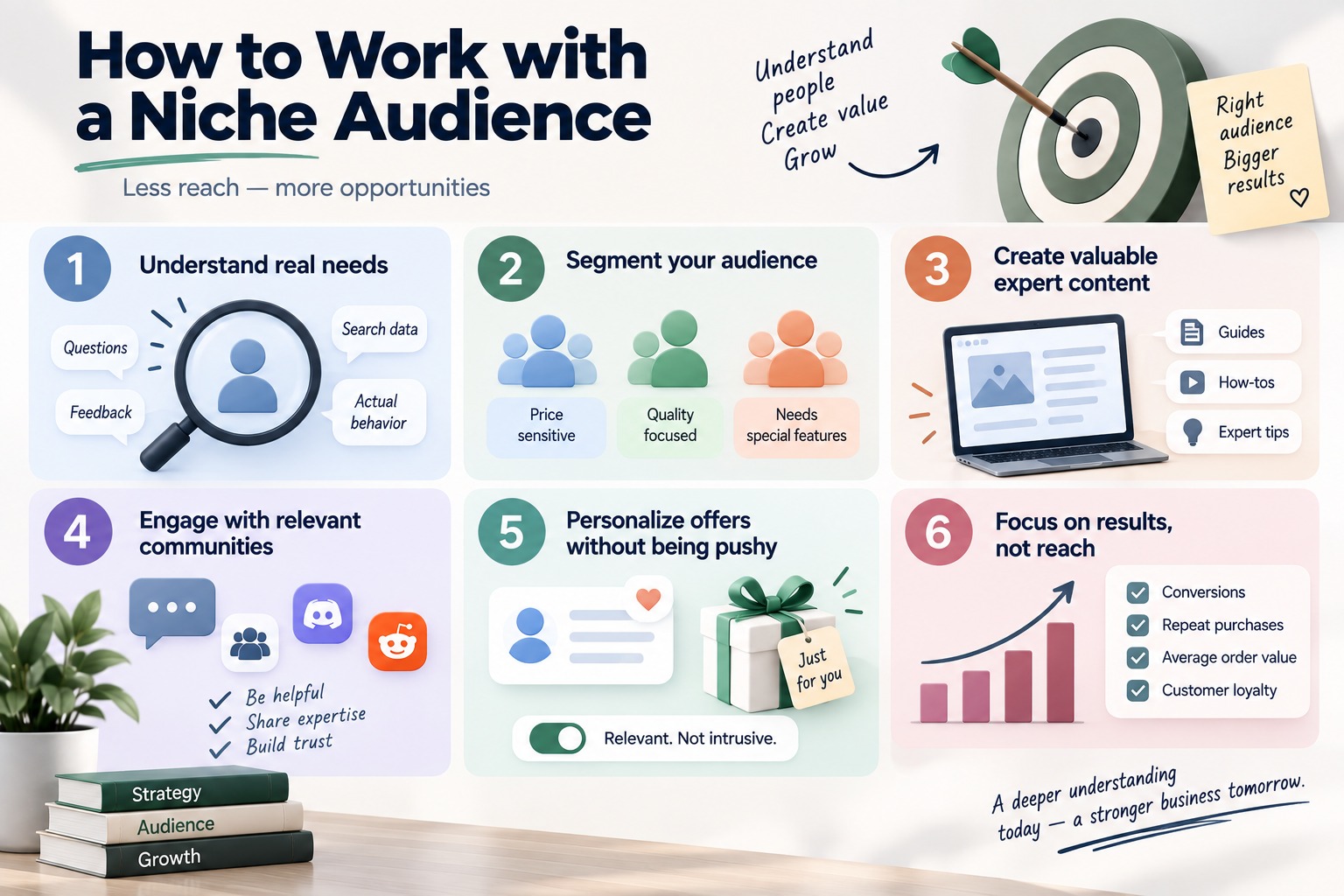
Understand real customer needs
The starting point should not be broad characteristics such as age or location, but the reasons behind a purchase.
Businesses need to understand what problem the product solves, what prevents customers from making a decision, which criteria influence their choice, and what concerns they may have before buying.
Useful insights can come from customer support requests, reviews, search queries, comments, purchase history, and website behavior. First-party business data is particularly valuable because it reflects the actions of real customers rather than assumed interest.
Divide the audience into smaller segments
Even within a narrow niche, customer needs can differ significantly. Some buyers may prioritize price, while others care more about quality, speed, specialized features, or the seller’s expertise.
As a result, a single offer aimed at the entire audience often performs worse than several more targeted approaches.
Segmentation allows businesses to create separate offers, landing pages, email campaigns, and advertising messages for different customer needs. AI-powered tools can also be used to analyze large volumes of customer inquiries and reviews, but final decisions should be based on actual customer behavior and verified data.
Create useful, expert-led content
General advertising is rarely enough for a niche audience. More valuable are materials that help customers understand the subject and make informed decisions, such as guides, comparisons, explanations of common mistakes, frequently asked questions, use cases, and buying recommendations.
Content should focus on specific questions and problems that matter to the target audience.
This approach can help attract interested customers not only through search engines, but also through social media, specialized communities, and AI-powered platforms, which are increasingly becoming a starting point for information discovery.

Engage with relevant communities
Niche audiences often gather around professional platforms, specialized social channels, forums, online groups, and private communities.
Direct advertising in these spaces may be met with skepticism, so businesses can often achieve better results by contributing useful information, answering questions, and providing expert commentary.
Another effective channel is collaboration with creators who run smaller, highly specialized platforms or communities. In niche markets, audience relevance and engagement can be more important than total follower count.
Personalize offers without becoming intrusive
Niche audiences often respond well to offers that match their interests, but excessive data collection can reduce trust.
A more balanced approach is to use information customers voluntarily provide when creating an account, making a purchase, subscribing to updates, or completing a questionnaire.
This data can then be used to recommend relevant products, personalize email content, and create special offers based on demonstrated customer interests.
Measure results, not just reach
For a niche business, the number of views or followers alone provides limited insight into performance.
More useful metrics include conversion rates, customer acquisition cost, repeat purchases, average order value, the number of qualified inquiries, and customer retention.
Businesses should also compare these metrics regularly against their goals and adjust their marketing strategy based on the results.
Working with a niche audience requires precision and consistency. The better a business understands the real needs and challenges of its customers, the easier it becomes to create relevant products, reduce marketing costs, and build a stable, loyal customer base.